Biological disguise and adaptation
The People UpstairsBiological disguise and adaptation is the material basis of the Greenes’ life on Earth: it converts bodies that would be unmistakably alien into bodies that can pass, at least provisionally, as human. The process is not a simple costume change. It joins medical intervention, manufactured surfaces, altered domestic objects, learned behavior, and social concealment, making identity a continuous labor performed by both flesh and technology.
Appearance and Operation
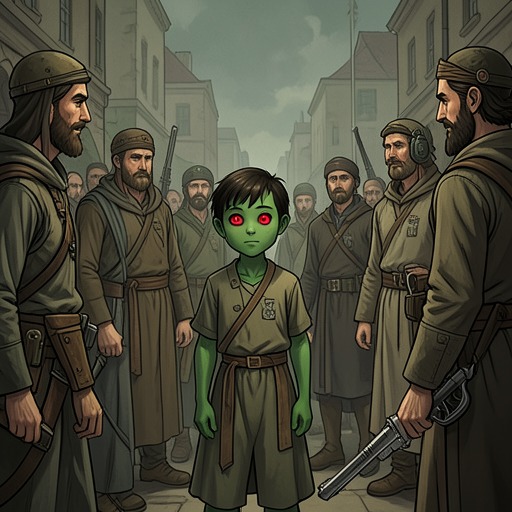
Dan Greene’s natural body is humanoid but visibly nonhuman by Earth standards. His skin is a dull, reasonable light green, and his eyes have restrained maroon-red pupils. He was selected on Milotis partly because this appearance was ordinary there, while his ability and his unremarkable overall presence made him suitable for covert work. On Earth, however, the same body requires concealment. His hands are broad and built to support more than five fingers, a difference that the narrative reduces to a stark double incompatibility: they are the wrong color for Earth and have the wrong number of fingers for Milotis.
May Greene’s disguise is similarly intimate. She can peel a silk-thin plastomask from her face and remove Milotan contact lenses, revealing that the apparently human surface is manufactured. Her hair is genuinely hers, but it has been dyed an Earth pepper-and-salt shade. Even the hairbrush is terrestrial in origin, because Milotan artifacts cannot safely be left in the apartment, yet it has been subtly altered to accommodate her needs. These details show how thoroughly concealment reaches into ordinary life: the Greenes must not only look human in public but also make their private possessions conform to the material expectations of Earth.
The apartment reinforces the same strategy. Its brown monotones and tweedy textures reproduce the conventional department-store modern style that had been fashionable when the Greenes moved in. Beneath this deliberate banality remains a slight emotional impression of alienness, difficult for a human observer to identify. The impression does not usually become evidence, especially because the building superintendent is too consumed by continual rage to register subtle undertones. Disguise therefore operates partly through objects and surroundings, not only through the visible body.
Permanent Adaptation and Its Costs
The Greenes’ Earth assignment was designed as a lifetime posting, and their adaptations were consequently more drastic than removable cosmetic concealment. They included amputations, leaving the agents as much monstrosities on Milotis as their natural forms would make them appear on Earth. The adaptations solve one problem by creating another: a body engineered to pass on Earth cannot simply be restored when the assignment ends. May understands that the Bureau will never reassign them to an Earth post and that returning home will be difficult because their bodies can no longer adapt back.
This permanence gives the disguise its tragic force. The Greenes are not merely pretending to belong to Earth; they have been physically remade in order to occupy it, and the remaking has severed their easy return to Milotan life. Their bodies become evidence of a political system that treats agents as instruments of long-term infiltration. The state can send them away, but the biological consequences of service remain with them, making adaptation a form of irreversible exile.
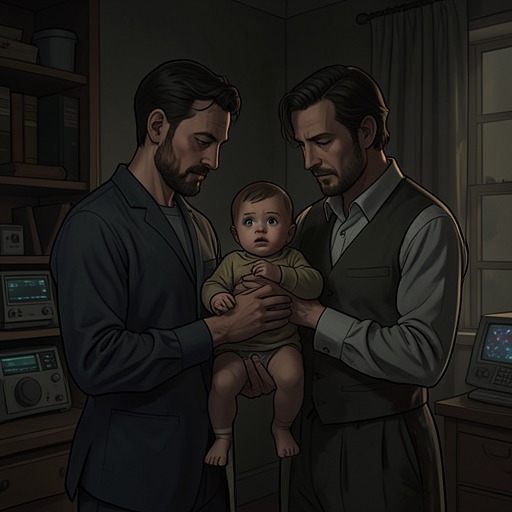
Terence Greene extends this process into the next generation. After his birth, Dr. Robinson fitted him with little masks and lenses in a laboratory unusually complete for a New Jersey general practitioner. The equipment allows the child to resemble a terrestrial infant, but it is expensive, and the Greenes can scarcely afford it. Terence also grows more slowly than a terrestrial child, reflecting the longer Milotan life span and delayed maturity. His body thus demands a continuing technological supplement before he can participate in ordinary human life.
Social Passing and Exposure
The disguises do not remove the pressure of human institutions. Terence’s delayed walking and speech cause the neighbors to regard him as backward, and May is forced to endure that judgment even while recognizing that Earth culture has partly conditioned her own view of him. The child’s apparent deficiency is therefore produced at the intersection of biological difference and social expectation: his body does not conform to human developmental timing, while the surrounding culture has no framework for interpreting what he is.
The most dangerous test arrives at school. Swimming lessons require the children to appear unclothed or nearly so, and the Greenes’ ordinary concealment cannot survive that setting. Terence returns distressed and tells May that he is different; the statement functions as an accusation because the adaptations have protected the parents’ secret while leaving the child without an explanation for his alien body. The principal condemns May for not informing the school that the boy was a freak and says that, had she known, she would never have allowed him to swim with the others. The episode exposes the limits of a disguise designed for surfaces, clothing, and controlled encounters: institutional routines can force the hidden body into view.
Yet exposure is immediately translated through human assumptions rather than recognized as proof of extraterrestrial life. The principal interprets Terence’s condition as the result of radiation from bombs and imagines that authorities have concealed dangerous mutations. May exploits this mistaken explanation, presenting the family’s secrecy as the consequence of medical uncertainty, X-rays, and the possibility that the pregnancy had first been mistaken for a tumor. The episode turns the disguise into a system of competing interpretations: the body is visible, but its meaning remains concealed because observers fit it into familiar categories such as mutation, illness, or wartime contamination.
Medicine, Technology, and Identity
Medical technology both preserves and threatens the Greenes’ identity. Dr. Robinson can supply masks and lenses for Terence and offers May a procedure to end her unexpected pregnancy without reporting it to Milotis. His offer frames the pregnancy as a condition that can be removed, while May refuses because she has always wanted a child. The same medical sphere that enables biological adaptation therefore also presents reproduction itself as a problem to be corrected.
The school episode repeats this medicalizing pattern. The principal’s explanation turns Terence into a possible victim of radiation and treats his difference as a concealed public danger, while May counters with an account involving tumors and X-rays. Neither explanation reaches the truth, but both show how institutions interpret unfamiliar bodies through diagnosis. The alien body is not simply seen; it is classified, explained, and potentially managed by the medical imagination.
At the end, Terence’s disguise is described through the plastoskin encasing his small, mutilated hand. May touches that artificial covering while driving him home, and the gesture joins maternal tenderness to the visible mark of technological and surgical alteration. She then tells him that the family will send a beam back to Milotis to report everything about him. Communication technology closes the circuit begun by the disguises: the same covert apparatus that helped sustain life on Earth now carries news of the Earth-born child back to the world from which his parents came.
Narrative Significance
Biological disguise and adaptation makes the story’s alien premise concrete while refusing to treat identity as an essence safely hidden beneath a surface. The Greenes’ bodies are altered by political assignment, their possessions are modified for local credibility, and Terence’s development is judged by institutions that mistake difference for defect. The disguise permits assimilation, but assimilation exacts a bodily price and produces a permanent uncertainty about where the adapted subject belongs.
The recurring contrast between appearance and interpretation also gives the action its irony. Mrs. Danko senses that something is different and mutters about the evil eye or a changeling, while the school principal explains the same difference through bombs and radiation. Human observers repeatedly recognize strangeness without recognizing its source. The disguise succeeds not because it makes the Greenes perfectly human, but because Earth’s categories are limited enough to absorb the evidence into superstition, xenophobia, medical anxiety, or political rumor.
The final disclosure to Terence changes the function of adaptation. Until then, masks, lenses, plastoskin, altered objects, and concealment have been tools imposed by survival and secrecy. Once Terence learns that Milotis exists and that his parents have not invented their account, the disguise becomes part of an inherited alien identity that must be reported and interpreted rather than merely hidden. Biological adaptation has kept him alive among humans, but it has also made his body the document through which both Earth and Milotis will decide what he is.